CON ANIMA monograph - 2025 - published by Jap Sam Books - design PutGootinkDesign
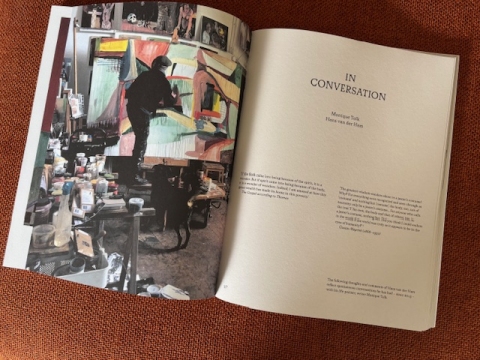
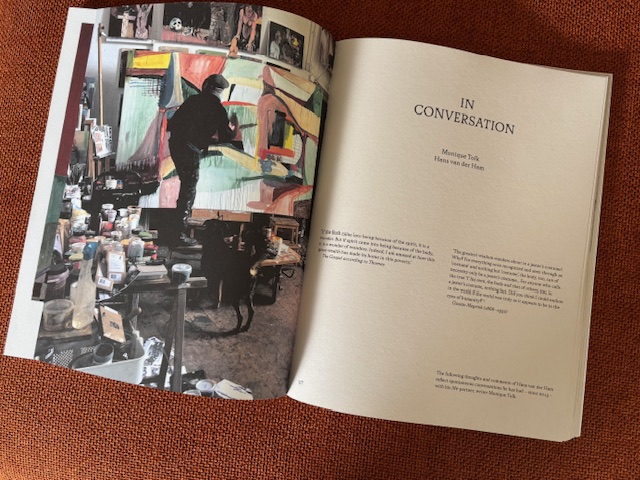
The following statements and thoughts by Hans van der Ham reflect spontaneous conversations that have arisen over the years (since 2013) between him and his life partner and writer Monique Tolk.
“If the flesh came into being because of the spirit, it is a wonder. But if spirit came into being because of the body, it is a wonder of wonders. Indeed, I am amazed at how this great wealth has made its home in this poverty.” (The Gospel According to Thomas)
“The highest wisdom walks in a fool's robe! Why? Because everything that one has once recognized and seen through as ‘clothing’ and nothing but ‘clothing,’ including the body, can only be a fool's robe… For anyone who calls the true ‘I’ their own, the body, and that of others, is a fool's robe, nothing more. Do you think I could endure in the world if the world were truly as it appears in the eyes of humanity?” Gustav Meyrink (1868-1932)
Outsiders and Artistry
M: We agree that all good artists are essentially outsiders. Do you feel like an outsider?
H: I still think I'm too much inside the lines. For an outsider, the outside world doesn't exist. They turn inward, enter a non-existent world; outsiders surprise themselves. I also want to be surprised by what I create, but I remain too aware of my context, the art world, and history. I'm constantly mindful of that, and it actually makes me unfree, a kind of inner unfreedom. Thinking gets in my way. In my opinion, an outsider is less bothered by that. They just do it. I admire the originality of that.
Music, Art, and Alchemy
M: You started out as a musician (ed.: conservatory, majoring in classical piano) but switched to art school immediately after graduating. What prompted that jump from music to visual arts? H: I wanted to create something that wasn't there yet. Everything I did before was re-creating what was already there.
M: You could have started composing.
H: I always found the immateriality of music difficult to deal with; the knowledge that it always has to be placed in time again; without a performer, it doesn't exist. Yet I still consider music the highest art form.
M: Why?
H: Precisely because it's a time-based art. Our lives also unfold in time. I think that's why you can also say that music "touches" you. It transports you to a different experience of time than your own. If that feels pleasant, it affects our emotions, which also unfold in time.
M: You've also said that music is more related to performance than visual art.
Even more than visual art, the performing music world is a very performance-oriented branch of art. So much so, that within the education that truly matters – the beauty of music – things are sometimes dragged in by the hair. It's often more about the marbles than the playing. In other words: the technical skill is more important than the art itself. The danger exists that the music world will increasingly degenerate into a ruthless race to the finish, instead of music being a means to something higher. And that's ultimately what it's all about.
H: Right. You can explain why one person plays a sonata better than another, while in the creative arts this is highly debatable. It's a subjective judgment, because no two people create the same painting.
M: You've compared art to alchemy, how did that go again?
H: All art, including music, is essentially a transformation process, comparable to alchemy. Sound alone doesn't make music, just as paint on canvas alone isn't enough for a painting. An essential step is necessary for this. It must be transformed in such a way that the material is transcended. Only then can you speak of art.
M: Is there a composer to whom you feel most connected as a visual artist—rather than as a musician?
H: With Scriabin and Chopin. Scriabin might be closest to me as a painter, and Chopin is the sculptor for me. Scriabin was a spiritual man, wanting to unite all art forms. For example, he wrote a piece for piano and orchestra that also features a light organ. Especially in his later oeuvre, timbre is very important, even more so than with Chopin, who composed everything from the piano. That's perhaps why this music is such a paradise for pianists.
M: So he initially took the piano as the starting point for his compositions?
H: Yes, all his work originated from the piano; even when he wrote for other instruments, it was conceived from the piano.
M: So Chopin was essentially very technically oriented; he thinks, "I have clay, what can I make from it?" Something like that?
H: He did indeed have, as it were, one language, and he spoke with it. He didn't try to create or communicate it from another language: the piano. His poetry consisted of one language: the piano.
Independence and self-confidence
M: Some artists are picked up early at the academy and, in my opinion, therefore hardly get the chance to discover themselves and develop further. What are your thoughts on that?
H: I would experience this as a major threat to my development as an artist. They are marketed in such a way that it's impossible to compete. I doubt I could maintain my own trajectory in such a situation.
M: Would it feel like a kind of appeal?
H: Yes, something like that.
M: But that independence you espouse could also feel like a lack of stability.
H: A memory from my childhood reassures me in some way. As a child, I already dared to chart my own course, to conduct my own research. Research was more important to me than achieving anything. That's why I wanted to be an inventor. It had to be something very secret in a laboratory that no one knew about. In primary school, I copied inventions from popular science books. Those could come in handy later. In fact, an artist is also an inventor. That's where I see the beginning of daring to go my own way.
M: Would you like to offer anything to the current generation of young artists?
H: The only thing that comes to mind now is that wood that grows too quickly rarely becomes a strong tree. I hope that the mature trees remain an example for every future generation.
Art as solace
M: Do you think your parents' lack of understanding of who you were as a child worked to your advantage? That can feel unsafe, but at the same time, it can be an incentive to go your own way.
H: Because of that, I retreated into my own world quite quickly.
M: An escape from it?
H: I was more looking for solace. I see art as a solace for this incomprehensible existence. In art, time stands still for me.
M: Do you also dare to lose yourself in that time? Don't you find that scary?
H: No! It's much scarier not to find that solace. A vacation, for example, is very scary for me, because then I'm outside my jargon.
M: Don't you feel the need to get a grip on your existence?
H: No, I'd rather not. I also prefer to stay away from politics, sports, and the like; they confirm how the world works, a world of incomprehensible things over which I have no influence whatsoever.
Art for art's sake
M: What are your thoughts on engaged art?
H: For me, art must arise from a free spirit, not from a social, cultural, or gender-based motive. Art isn't a sounding board for current social life, especially not if it's imposed from above.
M: Agreed. But subconsciously, surely something you read in the newspaper in the morning will sometimes reappear in your work, in some form or another?
H: I don't believe in engaged art anyway. That comes through reason; in my opinion, it doesn't belong in art.
M: But shouldn't art also have to have meaning?
H: No. A specific meaning can be a starting point for creating a painting, but if it becomes visible in the final result, I'm done. The story shouldn't be superimposed.
'Children' are not commodities
M: To what extent does recognition play a role for you?
H: Recognition is very relative; it flatters your ego, but it also has a dual meaning. I see my works as my children. The idea of someone buying it almost feels like a betrayal to me. Then it becomes commodities: it disappears into an unknown wall, or worse, it ends up on the street or in a museum's storage facility. It loses the intrinsic value it had in your studio. You've conquered something for yourself, but as soon as it leaves your studio, it becomes a thing. You don't know what they'll do with it, not even in a museum.
M: So wouldn't you be able to release the pressure, since you have no control over the future? Wouldn't it be better to assume that the work stays in your studio, safe with the creator, in the den where it originated? And doesn't that provide peace during the creative process?
H: Somehow I think the happiest artist wants to remain an amateur at heart, because an amateur knows no limitations and no pressure.
M: Yet I also know you from times when you were afraid to work for the cat's violin.
H: I'm realistic enough to realize that working only for the cat's violin isn't sustainable. Nevertheless, I think many artists will agree with me that, in retrospect, this was the best period of their career.
M: In any case, you became a professional artist.
H: In a sense, against your will. I started painting during my studies at the conservatory. I took books about the great masters from the library and tried to master them. And at a certain point, the need for more depth arises, and then you know that it’s serious.
M: And that your work should find a good home, out of your studio. Right?
H: I really don't want to imagine my work being found in a dusty studio after my death.
Three-dimensional phase
M: After graduating in painting and then making only drawings for about ten years, you started making sculptures. Why?
H: I came into contact with ethnographic art and was endlessly fascinated by the idea that some peoples believe matter is animated. I inherited my interest in old utensils from my father at a young age, who collected all sorts of things. In retrospect, I think he, in his own way, also sought some kind of inspiration in these objects.
M: Didn't you once say that your tendency to philosophize as a child was already fueled by your father's melancholic nature?
H: Yes, I think so to some extent. He was intrigued by things from the past with their own story. M: But how did that step towards sculpting actually happen?
H: The concrete step to start sculpting myself happened when, after a trip to India (in 1999), I decided to stop making art. It was unbearable for me that on one side of the world people were dying because they had nothing to eat, while I was sitting in my studio, pondering what I would make next. So I decided to make one more thing: a small sculpture. So I bought a block of beeswax and started sculpting a small statue as a farewell. When it was finished, people around me urged me to continue. I was completely sold, and the statue immediately found a buyer. What was meant to be an ending turned out to be a new beginning! I also realized that I wouldn't be helping anyone in India if I stopped making art, but that by making art, I could at least make people happy here. Subsequently, I built up a body of work over the next twenty years, mainly in clay. M: Concluding with a sculpture in a public space that was unveiled in 2022 on Mathenesserlaan in Rotterdam. And in the meantime, you switched from clay to plaster.
M: Did you consciously want to embark on a new path with that?
H: I wanted to break free from the limitations of clay. A whole new world opened up for me, because you can work so quickly with plaster and make endless changes. This happened in 2020 when I was working towards MEHR LICHT! (ed.: solo exhibition at Galerie Larik, Utrecht). And from there, the need grew to return to my old craft, painting. The freedom I had gained by working with plaster enabled me to do this; painting took on a different impetus than before.
M: You could say that MEHR LICHT! literally shed a different light on your work.
H: It indeed happened without my knowledge.
M: How different is the experience of working on two-dimensional or three-dimensional art? H: Compared to a sculpture, a drawing or painting requires more illusionary space. It demands more imagination and empathy from the viewer. This is in contrast to a sculpture, where you're more in an objective space and can simply walk around it. The difference in dimensions strongly influences the production process. An image was already in my mind before I sculpted it, while a painting or drawing develops gradually.
M: And you can also work longer on a two-dimensional work; you can keep tinkering with it and revisit the process. With a three-dimensional work, that seems difficult, right?
H: That's right.
Color in small and large works
M: It actually took years before you started painting on large canvases. Why is that?
H: At the time, I was making gouaches on paper and panel. Small works. Even at that size, you can create an entire, illusionary world. I thought then that if I enlarged my work on a large canvas, it would lose its expressiveness: I believed I could make a bigger impact on a smaller surface. You kept insisting that my work screamed for large canvases. And you were right.
M: Until a few years ago, you also thought you had no sense of color, and now you're admired for your use of color. Why did you think that?
H: I've completely let go of this belief and my idea that I could only keep up with the story with black-and-white drawings (ink and charcoal). The color now pops off the canvas!
M: You keep the paint recipe a secret. Why is that?
H: As an art student (ed.: Willem de Kooning, Rotterdam), I once attended an artist talk by Markus Lüpertz. I noticed something unusual in his paint structure and decided to ask him about it personally at the end of his talk. He found it remarkable that I had noticed this and, to my surprise, entrusted me with the recipe for his paint. I still make my paint this way. Now, Lüpertz was one of my greatest examples, so I think it has to be that way.
Creating and Destroying
M: How do you actually work in your paintings?
H: I start a painting with an abstract background, an atmosphere. Sometimes I see a kind of figuration emerging in that abstraction, and I develop it further. It appeals to my subconscious. A new painting is like entering a labyrinth. The exit is unknown. But the beast has to be released from its cage, so I paint quickly, otherwise my mind (and inhibitions) have a chance to block the exit. I believe the work should be created in a single flow. The background is comparable to an orchestral score, where the soloists naturally emerge.
M: You once described the process a work of art goes through beautifully metaphorically. How did that go again? H: I see an artist as someone who lugs something up a mountain, and once it's there, someone on the other side of that same mountain sees something lying there and becomes curious about it. That person has climbed that same mountain independently of the artist, via a different route, and at the summit, both meet in the work.
M: Kees Spermon, one of the teachers you studied with at the academy, once said that no matter how successful you are in your career, the biggest challenge is ultimately standing in front of that blank canvas every day.
H: He was a very important person to me. The first person who gave me self-confidence.
M: You sometimes talk about a certain panic at the start of a new work. Don't you think that panic is precisely what creates the best works?
H: You always say that.
M: Yes, the moment you panic at home and shout, "I can't do this anymore," I know something big is about to happen.
H: You've got me by the balls.
M: But panic can also arise when you're waging an endless battle with a work and an inner critic shouting, "Kill your darling!"
H: Yes, then I destroy it, after which I gain the freedom I need to give up the fight. Then a pressure falls away, creating space for inner freedom. If you have something that makes you very happy, but somewhere it feels like it's not working, then you have to destroy it. You know deep down that it will yield something better.
M: Don't you find that scary?
H: It's still a gamble, because you already had something. And yet you have to dare to destroy it, confident in your own ability that you can always restore it to its original state. Overcoming fear produces good art. Picasso said in his old age: "You must dare to destroy and always dare more."
M: "Destroy" is actually a relative term, because although it becomes a second version, you can always paint over it.
H: Yes, but the first version is then lost. Recently, a student confronted me with the limitations of creative art. He argued that once music has entered the world, it remains unchangeable, even after the performer has stopped and the sheet music is put away. I think this is a beautiful thought from a ten-year-old. Paintings can indeed be painted over, but music cannot. In that sense, music is more lasting because it is immaterial; it spreads through the ether.
M: How does this work with piano lessons? What about the content input? How does that work?
H: I actually see piano lessons as sculpting a sculpture together. I've done it more often than my students, so I know my way around to some extent. It's wonderful to experience how centuries-old knowledge is passed on and comes to play a role in someone's life.
M: When is a painting finished?
H: When nothing bothers me anymore. M: And the construction of your oeuvre—an artist goes through a process, develops an idiom, but I always feel that as soon as you get started, you quickly take a different path. Do you force yourself to always try something different? How does that work?
H: I don't want to be consistent in creating paintings; I would force myself to do the same thing over and over again. Painting blocks on a canvas every day, but slightly differently—how fascinating is that? Or imagine if I said the same thing to you every day. For me, it's about the research; that's what being an artist is all about. I feel like I'm in a playground; playing with the same toys every day isn't fun.
Drawing like walking a tightrope
M: Do you experience a difference in the process of creating a drawing or painting?
H: A drawing relies on its directness and thus appeals to the subconscious in a different, more intense way. Drawing has a tension that can be torturous. I see drawing in ink as walking a tightrope: once you start walking, it's questionable whether you'll make it safely to the other side—there's no safe way back. It's also comparable to music: playing a musical line is also final; you can't go back on it because it's already irrevocably played out in time.
It's unlike painting. You can postpone the final image longer, which gives you more space to delve into the subconscious and for further exploration.
Horror vacui
M: What exactly does your studio day look like?
H: My day usually starts with panic, and when I force myself to continue, I get an entrance into the painting, and suddenly anything is possible. Then I'm lord and master; I've killed the bull, so to speak, but first it wins over me. My peak of inspiration is usually around four in the afternoon.
M: Do you think you need that emptiness that precedes it?
H: Apparently.
M: Don't you run out of time then?
H: The empty white surface is absolute panic every time; then I think it won't work. Once I've got some paint on it, I gain more confidence and work quickly. Then I get into a flow, where it's not me, but IT that's painting.
M: Does the tension disappear then? H: On the one hand, there's the flow, but on the other, the inner critic remains active. But only in this way can I further develop my work and place it in the context of the art world. And avoid it becoming a noncommittal repetition.
M: The word "panic" keeps recurring; it's apparently an insurmountable torment during your work.
H: It subconsciously challenges me to push myself to the limit, and in a sense, I'm grateful for that.
Question of humanity
M: The figures you've incorporated into your sculptures are only visible in their disguise. I've always accepted that as reality, based on a certain personal recognition. But how do you experience this?
H: In 2008, I had an exhibition in a German gallery entitled: Armour Show. This was a surreptitious reference to the prestigious Armour Show, a contemporary art fair held annually in New York. The title also literally referred to the word "armor" or "armor." The images I showed consisted primarily of coverings, costumes, and/or suits, which, in their original form, were intended to offer a certain protection or identity. However, the suits were visibly empty. What was visible, however, was in a specific pose, which conveyed something about the wearer's inner attitude. The absence of the wearer's true identity lends the images a certain mystery and allows the viewer to identify with them.
M: The images were once associated with characters from the commedia dell'arte, the street theater in 17th- and 18th-century Italy (ed.: article Through the Mirror, mediamatic.net 2010). Archetypal narrative figures who fooled people behind masks that concealed their true identities. Your images, the coverings, were compared to a fool's robe.
H: Masks allow the potential wearer to conceal their own identity, similar to what happens at carnival. M: Even as a child, you were intrigued by the concept of identity.
H: A question that has occupied me my whole life is who we are and what a human being even is in this world. As a child, I would pinch our nanny's arm to check if she was "real." I thought she might be dressed in a "human costume." I was also convinced that adults were hiding a secret that I, as a child, had to uncover in my life. I wondered why they wouldn't tell me right away. I soon realized that we all come into this world unbidden and must forge our own paths.
M: The story by Hector Malot, "Alone in the World," that your father read to you as a child?
H: Yes, that story made a deep impression on me. But also the story about Pinocchio (ed.: author Carlo Collodi), originally written for children as a moral lesson about the tragedy of existence. It's actually an esoteric story. Carlo Collodi was a nineteenth-century Italian and a Freemason. Therefore, I wouldn't be surprised if Pinocchio is based on Pulcinella, the alias from the commedia dell'arte, which also originated in Italy. Pulcinella held up a mirror to people and, like Pinocchio, confronted them with the tragedy of existence, life, and death.
M: It's also about the quest for purity.
H: Pulcinella means "chick," and in the sixteenth and seventeenth centuries, the era of the commedia dell'arte, the black rooster represented the omnipresent death, hence Pulcinella's (bird) mask being half white and half black. This bird figure eventually reappeared in the eighteenth century in Mozart's opera "The Magic Flute." This time in the guise of the bird-catcher Papageno, the idiot who makes the audience laugh with jokes and jokes, but who simultaneously holds up a mirror to the other characters. Mozart was also a Freemason, as was the opera's librettist, Emanuel Schikaneder. It is therefore not surprising that this opera is based on an alchemical story and is about the search for pure ness, to the 'inner gold'.
Limitations of material life
M: Do you recognize something of yourself in Pinocchio?
H: Perhaps, in the guise of a wooden puppet who has also been brought to life unbidden and, against his will, must become a 'real' little boy of flesh and blood. I find that a deeply tragic concept. There is no way back for him; he must follow the path of the people.
M: Perhaps Pinocchio felt lost as an individual? It reminds me of the exhibition Individual en masse, in which you participated with your clay sculptures (ed.: Kadmium, Delft 2017).
H: Humans, and probably artists even more so, experience the discrepancy between the security of belonging to a group on the one hand and the loss of control over one's own autonomy on the other. In the exhibition Individual en masse, I wrestled with the question of who we are apart from the masses. It's still a nightmare for me that we never know for sure what identity, who, or what lies behind a figure.
M: The concept of identity plays an important role in your images.
H: In Gnosticism, but also earlier with Plato, it was assumed that in order to become human, we descended into matter. You find the same principle in the (Gnostic) Gospel of Thomas. We have, as it were, landed in something—matter—which is a vehicle for something else—the soul. But the human identity thus created simultaneously entails a limitation, because you want much more than you can possibly achieve. For example, we can talk to each other, but we have to search for a form to connect. We only have words, our facial expressions and motor skills, nothing more.
M: And symbols.
H: Right. In fact, we never know exactly what we have in each other. All our behavior is based on codes learned in childhood. A smile, for example, or a raised hand in greeting is generally interpreted as safe: "Don't worry, I won't do anything to you." These are recognized symbols in almost all cultures. But in reality, we're never entirely sure. Someone can always hide their true nature. That's also the fascinating thing about our existence. We always need something material to convey something to each other, to give it shape. But this is never entirely sufficient. In that way, you could always hide your true self and the intentions associated with it behind a mask.
M: You've also cited Greek mythology in this context.
H: Yes, there's an exemplary story that really resonates with me. About Pyramus and Thisbe: due to a difference in status between their families, they could only communicate secretly as lovers through a crack in the wall of their adjoining cellars. When they finally manage to meet (illegally), it ends badly. Shortly after each other, they die of love. To me, this indicates how limited we are as humans; we have to make do with that little crack in the wall. And who knows, maybe that's the reason people started making art in the first place.
M: As a form of solace?
H: Perhaps. In my work, I try to evoke something timeless. Dreams also reveal a kind of nonexistent time and are therefore extremely interesting to me. Being without time is a realm we can't reach with our minds; it's inexpressible.
Subconscious and Underworld
M: Could it be that your longing for the surreal, for a subworld, is an extension of this? And—if I may call it that—even the underworld?
H: Yes, the underworld has always fascinated me.
M: When something fascinates you, you want to find out something. Do you know exactly what it is, and have you found it?
H: I see the underworld as a dark cave, where you don't have to be anyone and where you can give up your identity. M: Do you feel safe there, in a sense, within a kind of anonymity?
H: I'm curious about it, drawn to it, I don't know exactly why.
M: During your many travels through Asia, you often deviated from the usual routes and found yourself in places where you were seriously at risk.
H: I really wanted to immerse myself in another culture, and if you surrender to that, you naturally end up in less flourishing places. For example, Bangkok has a vast underworld, so you almost can't avoid encountering it. Strangely enough, I felt at home there. I find it fascinating to move anonymously and observe these (sub)worlds. Traveling in such a culture is somewhat comparable to carnival. You can forget your own self for a moment.
M: It seems to me as if you feel safe in these underworlds and are detached from the outside world there. Isn't there also a connection to your images, which, as it were, hide from reality? In your images and in fact in all your work I recognize something vulnerable, something almost clumsy. And despite the robust clay of these figures, they They strike me as fragile creatures questioning their own existence. As if they want to protect themselves from an unsafe outside world.
H: I'm indeed concerned with showing something of the vulnerability of our existence by making vulnerable and personal precisely what could offer protection. I hope the viewer recognizes something of themselves in it, a kind of recognition hidden within.
M: Faces are often missing.
H: By omitting something so essential, the viewer can identify with it more easily. What remains is the attitude.
M: They can also be frightening, don't you think?
H: Actually, they're only truly good when they scare you a little, when they evoke something.
M: You yourself have been frightened by one of your sculptures before.
H: That's right. I made a life-sized sculpture that had to be assembled from parts, and then I suddenly felt a shock; I feared it would move. Such images continue to confront me, and that can have a long-lasting effect. M: When we lived in the studio and I walked past the sculptures in your studio at night to go to the bathroom, I had the feeling that they heard me coming and immediately stopped what they were doing. A rather surreal experience.
H: Yes, the sculptures almost felt like roommates.
M: You later incorporated this idea into the exhibition you created for Museum Boijmans Van Beuningen (ed.: Van der Ham guest-curated the exhibition ANIMA MUNDI, 2018).
ANIMA MUNDI
M: In ANIMA MUNDI, the fascination with the possible animation of inanimate matter resurfaced. But how did this fascination actually arise?
H: This is a timeless theme, and much research has been conducted on it. For a tribal artist, it is primarily important that the artwork "works," otherwise it has no value. The sculpture or object must represent an ancestor or deity. This is taken very literally. Sacrifices are made and treated with respect. The inspiration lies in something that resonates within a work. It doesn't have to be perfect for that. The creators of these sculptures don't strive for aesthetic perfection, but for functionality. That makes them very realistic and therefore absolutely not decorative. I wanted to reflect that in my sculptures and in ANIMA MUNDI and evoke a kind of awareness of who we truly are. I explored precisely this theme of animated, inanimate matter in ANIMA MUNDI, by juxtaposing contemporary art with ancient art, ethnography, and developments in science such as robotics.
M: What a resounding success! (Editor's note: the exhibition received attention from both national and international media.)
H: To my surprise, indeed.
M: Do you think the exhibitions you created as artistic director/curator for Garage Rotterdam subconsciously led to ANIMA MUNDI? The themes of those exhibitions were also predominantly spiritual in nature. (Editor's note: Van der Ham was co-founder/artistic director/curator of Garage Rotterdam from 2011-2015)
H: I more or less learned the ropes at Garage Rotterdam. Curating exhibitions requires skills, which I taught myself. After my time at Garage Rotterdam, I wanted to use these skills for a larger project, like the one for Museum Boijmans Van Beuningen. That led to ANIMA MUNDI, and for me as a curator, it has been the most beautiful and largest project so far.
M: Where did the urge to curate exhibitions come from, to tell stories using other people's work, existing art? What makes it different from doing this through your own work? Did it have to do with a desire to highlight favorite artists?
H: No, they were dragged in by the hair; it was about the story I wanted to tell. This often started with a fascination with a particular artist, from which a theme emerged that took on a life of its own in my mind. Gradually, other artists joined, each exploring the theme from a different angle. The result was often that the first artist whose work had triggered the project didn't make it to the finish line because a theme had taken such a turn that their work no longer fit within it.
Inspired Curator
M: During your curatorship, I sensed a restlessness in the development of your own studio, a drive for experimentation, and a constant questioning of your work up to that point. Ultimately, curating may have helped you shed new light on your own work through studio visits and conversations with fellow artists. What are your thoughts on that? Has curating influenced your artistic practice?
H: When I started as a curator for Garage Rotterdam, I feared the art world would think I'd taken a curatorial job because I might not make it as an artist. My gallery owner at the time (ed. Erik Bos of the Nouvelles Images gallery also passed away during this period, so I was very uncertain about which gallery I would continue with. When it was noted after ANIMA MUNDI that such an exhibition, like the exhibitions for Garage Rotterdam, could only have been created by an artist, I somehow felt an enormous urge to pick up the thread in my studio more intensively than ever, regardless of whether a suitable gallery would come my way. The studio visits of fellow artists during this curatorial period and the reflection on my own work up to that point certainly gave me a boost in my own work. But meeting you in 2013, the artistic background you turned out to have, also certainly contributed to this boost.
M: You know I secretly enjoy looking over your shoulder in your studio, but I associate your greatest development as an artist with your eagerness to explore. And apparently, that was already there as a child. Would you like to develop further as a curator, perhaps internationally?
H: I have plenty of curatorial ideas, but not enough time. My drive to paint is so strong that I want to use every minute in my studio.
The meaning of existence
M: I sense a search for meaning throughout your oeuvre. And much of what you've read about this is reflected in your work.
H: I've been fascinated by existence since childhood. I often wonder what the meaning of everything is and why things are the way they are. I like to cling to the romantic image that our invisible world is a container for another, invisible world. You could see humans as a metaphor for something of which they are actually only a vehicle. The paradox is that by concealing something visible, you can also become more aware of what is concealed. That's actually what I try to show in my work.
M: And that key figure, Pinocchio, what's his position in that? H: Pinocchio also makes me think of current developments in biotechnology. The idea of a malleable human seems to be on its way. Self-thinking robots are becoming a realistic threat. Soon we'll all be Pinocchios, golems, and Frankenstein's monsters. I find that fascinating. But also frightening.